The elections of
May 30, 1996, were for delegates to the peace talks and to
the Northern Ireland Forum
which ran in parallel with the two-year talks process. The very
idea of holding elections was controversial and is believed by
some to have contributed to the resumption of violence by the IRA
in February of that year. Various options were considered,
including: a list system election with Northern Ireland as a
single constituency; an 'indexation' system, where the
relationship between seats and votes would have been non-linear;
pairing off the new constituencies to make nine electoral
districts; and the old favourite of the single transferable vote
in each parliamentary constituency. The system eventually chosen
for the May 30 Forum/talks elections included elements of all of
these. Each of the 18 new constituencies elected five
representatives from closed party lists using the d'Hondt formula.
In addition, each of the ten parties with the most votes across
Northern Ireland elected another two representatives. The total
number of potential delegates/Forum members was thus 110.
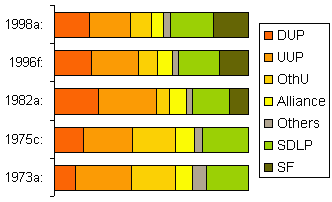
This graph
contrasts the 1996 elections with the elections for the Assembly
in 1998, the Assembly in 1982, the Constitutional Convention in
1975 and the Assembly in 1973.
The results of
the May 30, 1996 election were disappointing for the UUP, SDLP
and Alliance, but very gratifying for the other parties, in
particular Sinn Fein. (See spreadsheet
archive.) You can contrast the results with those in other
regional level elections here.
Each constituency can be examined in detail on the relevant page
of this site; the overall results were as follows:
UUP
181,829
votes
24.17%
28 + 2
= 30 seats
SDLP
160,786
votes
21.36%
19 + 2
= 21 seats
DUP
141,413
votes
18.80%
22 + 2
= 24 seats
SF
116,377
votes
15.47%
15 + 2
= 17 seats
Alliance
49,176
votes
6.54%
5 + 2 =
7 seats
UKUP
27,774
votes
3.69%
1 + 2 =
3 seats
PUP
26,082
votes
3.47%
2
top-up seats
UDP
16,715
votes
2.22%
2
top-up seats
NIWC
7,731
votes
1.03%
2
top-up seats
Labour
6,425
votes
0.85%
2
top-up seats
Green
Party
3,647
votes
0.49%
Conservatives
3,595
votes
0.48%
Workers
Party
3,530
votes
0.47%
Ulster
Independence Movement
2,125
votes
0.28%
Democratic
Left
1,215
votes
0.16%
Democratic
Partnership
1,046
votes
0.14%
Independent
McMullan
927
votes
0.12%
Independent
Chambers
567
votes
0.08%
Natural
Law Party
389
votes
0.05%
Independent
DUP
388
votes
0.05%
Arthur
Templeton
350
votes
0.05%
Ulster's
Independent Voice
204
votes
0.03%
Communist
Party
66
votes
0.01%
Ulster
Christian Democrats
31
votes
0.00%
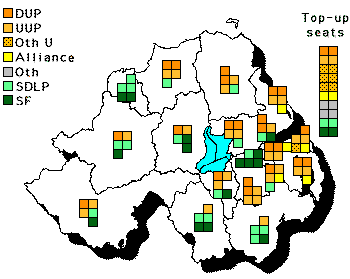
This graphic
shows the geographical distribution of seats won in the
elections.
The
multi-party talks began in June 1996 with only nine parties
present as Sinn Fein were barred while the IRA continued its
campaign of violence. All parties were entitled to come to
meetings of the Forum but Sinn Fein never took up their seats.
The SDLP withdrew from the Forum, but remained at the talks, in
July 1996. In July 1997 the renewed IRA ceasefire enabled Sinn
Fein to attend the talks; the DUP and UKUP promptly withdrew
from the talks and the UKUP withdrew from the Forum as well. In
1998 the UDP and Sinn Fein were both briefly suspended from the
talks as a result of breaches of the UDA and IRA ceasefires
respectively.
The bare
procedural summary in the last paragraph comes nowhere near
doing justice to the events of the last few years. A good place
to look for further information is the Irish Times' Path
to Peace site.
Notes
Although the DUP
got fewer votes than the SDLP they ended up with more seats, due
to the way the two parties' votes were geographically distributed.
Most of the
smaller groups or parties on the above list will not appear
elsewhere so this may be the best place to describe them:
Ulster
Independence Movement (UIM)
Speaks for
itself really. Also stood in the 1990 Upper Bann by-election
and the 1994 European Parliament election.
Democratic
Left (DL)
Was an
all-Ireland party with four members of the Dáil elected in
1997. In the 1998 Assembly elections they supported the Labour
candidates. Later in 1998 they merged with the Irish Labour
Party led by Ruari Quinn.
Democratic
Partnership
A
well-intentioned movement founded by former Peace People and
NI Labour personalities, now defunct.
Independent
McMullan
Led by a
North Antrim councillor but merged with the New Ireland Group
which is vaguely nationalist in a liberal sort of way.
McMullan stood unsuccessfully for the Assembly in 1998 as an
independent.
Independent
Chambers
Led by a
North Down councillor, definitely Unionist in ethos. Chambers
also stood unsuccessfully in 1998.
Independent
DUP
Another
small North Down based grouping, now defunct.
Arthur
Templeton
Veteran
South Antrim independent Unionist.
Ulster's
Independent Voice (UIV)
Yet
another small North Down grouping, also stood unsuccessfully
in 1998.
Communist
Party (CP)
Old
revolutionaries never die, they simply fade away.
Ulster
Christian Democrats (UCD)
Possibly
more eccentric than the Natural Law Party, wanted all churches
to recognise the Northern Irish state (a reference to the fact
that the main churches are all organised on an all-Ireland
basis) and a Chief Rabbi for Northern Ireland to be employed
by the state to teach the Old Testament (to whom he would
teach was never made clear). Still have a website at http://ucdp.bizhosting.com/
.
The special
nature of this election required special legislation which listed
those parties entitled to stand. Apart from the above named, the
list included two groups who were disqualified for not putting
forward enough candidates (the Northern Ireland Party, yet
another North Down eccentric, and Independent Patrick
McCaffrey from Fermanagh) and five who did not in the end
put forward any candidates at all (the British Ulster Unionist
Party of Professor Kennedy Lindsay; Independent Seamus
Kerr of Omagh; Independent Brian McGrath also of
Omagh; Independent Ian Sinclair, yet another North Down
figure; and No Going Back which was a Trotskyite front
whose members in the end backed Labour).
This page has been developed with the
support of a project grant from the New Initiatives Fund
of the Electoral Commission. However, any views expressed
on this page or, in particular, other pages of this
website are those of the author and not necessarily shared
by The Electoral Commission.
Nicholas
Whyte, 3 June 1998; last updated 7 May 2003 by Tineke Vaes.