The first preference
votes cast in the European election in Northern Ireland
on 10 June 1999 (see spreadsheet):
Democratic Unionist Party (Rev Ian Paisley
MP MEP MLA)
192,762 (28.4%)
Social Democratic and Labour Party (John
Hume MP MEP MLA)
190,731 (28.1%)
Ulster Unionist Party (Jim Nicholson MEP)
119,507 (17.6%)
Sinn Féin (Mitchell McLaughlin MLA)
117,643 (17.3%)
Progressive Unionist Party (David Ervine
MLA)
22,494 (3.31%)
United Kingdom Unionist Party (Bob
McCartney MP MLA)
20,283 (2.98%)
Alliance Party (Sean Neeson MLA)
14,391 (2.12%)
Natural Law Party (James Anderson)
998 (0.15%)
Turnout
was 687,573 of the 1,191,307 electorate. 8,764 votes were invalid;
678,809 votes were valid. The quota was 169,703.
Candidates'
previous electoral records
Paisley has been an MEP since 1979. He has
been Westminster MP for North Antrim
since 1970. He was elected to
Stormont in a by-election for
the Bannside constituency in 1970 (having lost in the 1968
general
election),
and has been elected at all five regional level contests since
(1973,
1975,
1982, 1996, 1998) from the North Antrim constituency. In 1968
and 1970
he stood as a Protestant Unionist but has been leader of the DUP
since
it was founded in the latter year.
Hume has been an MEP since 1979. He has been
Westminster MP for Foyle since 1983
(having been unsuccessful
in County Londonderry in October
1974). He was elected to Stormont as an independent in the Foyle
constituency
(much smaller than the later Westminster constituency of the
same name)
in the 1968 general election, and has been elected at all five
regional
level contests since (1973, 1975, 1982, 1996, 1998), from County
Londonderry
in the first three and then from Foyle. He was a founder of the
SDLP in
1970 and had been the party's leader since 1979.
Nicholson has been an MEP since 1989. He was
Westminster MP for Newry and Armagh
from 1983 to 1986, when
he resigned in protest at the
Anglo-Irish Agreement and lost the subsequent by-election (he
was again
unsuccessful in 1987). He was elected to the 1982-6 Assembly
from
County
Armagh. He was a member of Armagh District Council from 1975 to
1997.
McLaughlin stood unsuccessfully in Foyle in the 1997 Westminster
election. He was elected from Foyle in the 1996 and 1998
regional-level
elections. He has been a member of Derry
City Council since 1985.
Ervine stood unsuccessfully in South Belfast
in the 1997 Westminster
election. He was elected as a "top-up" delegate in the 1996
Forum
election
and also from East Belfast in the 1998
Assembly
election. He was elected
to Belfast City Council in 1997.
McCartney had been MP for North
Down since 1995, after two
unsuccessful
precious bids in 1983 and 1987. He was elected from North Down
in the
regional
level elections of 1982, 1996 and 1997. In 1982 and 1983 he was
a UUP
candidate;
in 1987 he broke with the party and stood as a Real Unionist; in
1995
he
founded the UK Unionist Party.
Neeson stood unsuccessfully for Westminster
in East Antrim in 1983,
1986, 1987, 1992 and 1997. He was elected to the 1982 Assembly
from
North
Antrim and to the 1996 Forum and 1998 Assembly from East Antrim.
He has
been a member of Carrickfergus District Council since 1973 (with
a
short
break in 1988-9). He had been leader of the Alliance Party since
1998.
Anderson stood unsuccessfully in the 1994 European election. He
also unsuccessfully contested Westminster elections in
Mid-Ulster
(1992),
North Down (1995), and South Belfast (1997). He was also a
candidate in
the 1996 Forum elections (from which he "withdrew" the Natural
Law
Party
a few weeks before polling day) and the 1998 Assembly elections
(in
South
Belfast). He was an unsucessful candidate in Belfast Laganbank
in the
1997
local elections. He appears to be the closest thing the Natural
Law
Party
in Northern Ireland has to a leader.
It
is difficult to know what to make of this election result, marking
as
it did a period of uncertainty in the peace process. Both McLaughlin
and
McCartney before the election were talking up their chances of
displacing
Nicholson; in the event, despite the UUP's historically low vote,
McCartney
was beaten by Nicholson, McLaughlin and Ervine, and McLaughlin would
have
needed another 50,000 votes to chalenge Nicholson seriously. Even
the
record slump
in the Alliance vote may not indicate much more than the party's
difficulty
in persuading even normally loyal supporters to vote for it in a
contest
which Alliance was unlikely to win and where moderates would be very
tempted
to strengthen Nicholson, Ervine and Hume against Paisley, McCartney
and
McLaughlin. The strength of the Nationalist vote compared with other
elections
of the last few years reflects more a differential turnout than a
real
demographic shift. However the real demographic shift is visible in
the
difference between this election and 1994.
Transfers
The
SDLP and DUP candidates (Hume and Paisley) were both declared
elected
on the first count as their votes exceeded the quota (169,703).
The
bottom four candidates (Nat Law, Alliance, UKUP and PUP) were
eliminated
and their votes redistributed to the only two contenders
remaining,
Nicholson
(UUP) and McLaughlin (SF). Of the 58,166 votes available,
Nicholson
received
43,120 and McLaughlin 1,709, leaving them with totals of 162,627
and
119,352
respectively after the second count.
Nicholson
was still short of the quota, so Paisley's surplus of 22,969
votes was redistributed between the two remaining candidates. Not
very
surprisingly Nicholson received the vast majority of these -
22,162 -
but
McLaughlin still managed to pick up 32 of them. Nicholson was now
well
ahead of McLaughlin, by 184,739 votes to 119,384, and also clear
of the
quota. He was therefore declared elected, completing the process
(Hume's
surplus of 21,028 votes could not have made a difference to the
outcome
at this stage).
Some
people express incredulity that any first preference vote for
Paisley
could end up with Sinn Féin, as 32 did in 1999 (and 59 in 1994).
Of course because these are fractions the true number may be six
or
seven
times as many. My attitude has always been that one should not
underestimate
the intelligence of the voter. Paisley's reputation for
constituency
work
is well known; I don't find it outside the realms of credibility
that
there
are a few hundred voters in the Glens who give him a first
preference
on
his local record rather than his policies, and then transfer to
Hume
(who
has already been elected) and SF before considering anyone else.
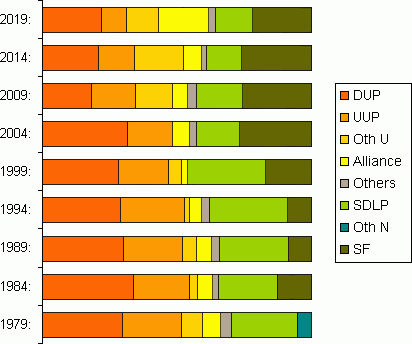
Past elections
This
graph shows the performances of the main parties in the five
direct
elections to the European parliament held so far (NB that the 2004
result in yellow is that of independent candidate John Gilliland,
not the Alliance Party). You can find a summary of the results of
the five most recent
NI
elections elsewhere and on a different
page
is a summary
of NI election results since 1973; see also the 1994
European election page.