

|
|
|
|
|
|
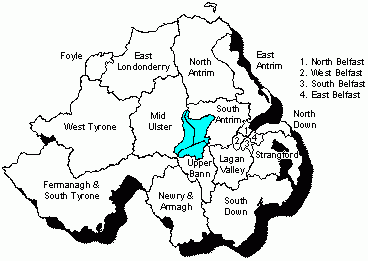
The Boundary Commission for Northern Ireland published its final proposed changes to the 18 parliamentary constituency boundaries on 3 October 2007. On the left, a map of the new constituencies by Conal Kelly. This is much more modest than the original set of changes in their provisional recommendations. I don't see any significant impact on the next Westminster elections as a result of the new boundaries. At Assembly level, there will now be now a safe Nationalist seat in East Antrim (where the SDLP won an unexpected seat in the 1998 elections, but lost it in 2003), and possibly others in Strangford and South Down, but Nationalist seats are under pressure in Lagan Valley and North Antrim.
The entrenchment of six Assembly seats per constituency in the Good Friday Agreement results in the under-representation of voters in Newry and Armagh, North Antrim and Upper Bann, which are all large enough to warrant a seventh seat at Assembly elections if they were allocated by size of electorate (South Down is heading this way too). Belfast voters, on the other hand, are over-represented, with both South and West Belfast really too small to qualify for a sixth seat, and East Belfast teetering on the edge. (North Belfast, thanks to swallowing Glengormley, is OK for now.)
The Boundary Commission had delayed finalising its proposals until
the new local government districts were settled. As could have been
predicted, almost the first act of the new devolved government was to
cancel the redrawing of the maps of local government, and so the 2007
constituencies are, unprecedentedly, based on the same building blocks
as the previous round in 1995. The Boundary Commission mutters that
"Once new ward boundaries are established, the Commission propose to
consider whether, exceptionally, to conduct an Interim Review of
constituencies", but the implication is that this would merely be
tinkering around the edges to bring the Westminster boundaries into
line with the local government wards, rather than carry out any more
major surgery.
The key changes are as follows (again, brilliant maps of the new dispensation by Conal Kelly):
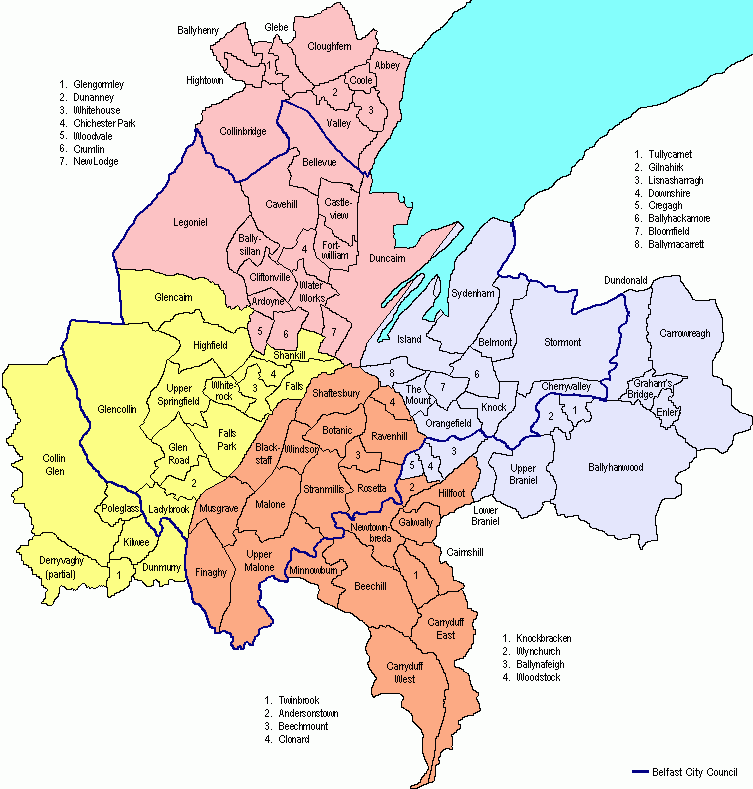
Belfast East constituency to include the Castlereagh LGD wards of Ballyhanwood, Carrowreagh, Dundonald, Enler and Graham’s Bridge. These wards are at present in the Strangford constituency.
Does it make sense?
Yes. The DUP successfully managed to persuade the Commission to keep
Cregagh in East Belfast - the previous recommendations would have moved
it to South Belfast, but the Commission has now swapped it for the
Hillfoot ward instead. It's fair enough; Cregagh is much more of a
typical East Belfast ward than Hillfoot.
Belfast North constituency to include the Newtownabbey LGD wards of Ballyhenry, Collinbridge, Glebe, Glengormley and Hightown, at present in the South Antrim constituency, and Cloughfern, at present in the East Antrim constituency.
Does it make sense? Broadly
yes. Specifically no. The weird division of the Shankill Road between
North and West Belfast remains, and the new boundary weaves through the
streets of Glengormley. Better to have left Cloughfern in East Antrim
and extended North Belfast a bit farther northwest, perhaps moveing the
Shankill entirely to West Belfast where most people think it is.
Belfast South constituency to include the Castlereagh LGD wards of Carryduff East and Carryduff West at present in the Strangford constituency, and Wynchurch and Hillfoot, at present in the Belfast East constituency;
Does it make sense? Yes; the boundary with East Belfast is a bit inelegant, but makes sense on the ground. Poor Carryduff has been shifted again (after being moved from Lagan Valley to Strangford in the last revision).
Belfast West constituency to include the Lisburn LGD wards of Dunmurry and part of Derryaghy, at present in the Lagan Valley constituency.
Does it make sense? Yes, apart from remarks about continued split of Shankill above under North Belfast. The split of Derryaghy ward is unprecedented, but actually makes perfect sense when you consider the facts on the ground. The original proposal would have included the rest of Derryaghy Ward and Seymour Hill, which are much more Lisburn- than West Belfast-oriented; it was right to abandon that idea.
 Strangford constituency loses to South and West Belfast as noted above; it gets the Down LGD wards of Ballymaglave, Ballynahinch East, and Kilmore. The wards at present form part of the South Down constituency.
Does it make sense? The most dubious of the new recommendations, in my view. It is news to me that Ballynahinch looks to Newtownards as a political centre.
South Down unchanged except for losses to Strangford (major changes in provisional recommendations withdrawn).
Does it make sense? See above remarks re Ballynahinch. The proposed division of Newry Town would only have restored the constituency boundary to where it was until 1983, but I guess the locals put up a strong case for no change.
Upper Bann unchanged.
Does it make sense? The minor alterations originally proposed were pretty silly.
Lagan Valley loses one and a half Dunmurry wards to West Belfast, and Glenavy to South Antrim.
Does it make sense? Recognises the demographic shifts; the splitting of Derryaghy is inelegant, but works on the ground.
East Antrim constituency to be extended to include the Moyle LGD wards of Glenaan, Glenariff, and Glendun at present in the North Antrim constituency (the shift of Ballycastle in the original recommendations is withdrawn, as is the silly proposal to rename East Antrim "Antrim Coast and Glens").
Does it make sense? No. At the southern end, it would have been better to shift a couple more Glengormley wards into North Belfast rather than Cloughfern. At the northern end, it's simply absurd to suggest that the Glens look to Jordanstown rather than Ballymena as a regional centre.
It is proposed to alter the boundaries of the East Londonderry and Foyle constituencies by transferring the two Derry LGD wards of Banagher and Claudy from the Foyle constituency to the East Londonderry constituency.
Does it make sense? Basically
yes. Foyle was bloated and East Londonderry under size. Not that the
two wards really look to Limavady rather than Derry, but I suppose you
have to make up the numbers.
No changes are proposed to the Fermanagh and South Tyrone, Mid Ulster, North Down and West Tyrone constituencies.
Does it make sense? In the
West, yes. Although the Mid-Ulster and West Tyrone constituencies are
both very new in their current form, they are reasonably sound natural
units and like Fermanagh-South Tyrone close enough to the quota that no
change is necessary. In the East, I am not so sure; tinkering with
North Down could have given a bit more flexibility for the
rearrangement of Strangford, say by shifting Donaghadee back.
See also: Jim Riley's analysis of votes and seats in the 1998 Assembly election | Gerrymandering | The constituencies | The political parties | The NI Executive | Useful books and links
Results from 1996 to 2001 for each seat: East Belfast | North Belfast | South Belfast | West Belfast | East Antrim | North Antrim | South Antrim | North Down | South Down | Fermanagh and South Tyrone | Foyle | Lagan Valley | East Londonderry | Mid Ulster | Newry and Armagh | Strangford | West Tyrone | Upper Bann
Surveys of each recent election: 2004 European | 2003 Assembly | 2001 Westminster | 2001 local govt | 2000 S Antrim | 1999 European | 1998 Assembly | 1997 local govt | 1997 Westminster | 1996 Forum | 1995 N Down | 1994 European | 1993 local govt | 1992 Westminster | 1989 European | 1989 local govt | 1987 Westminster | 1986 by-elections | 1985 local govt | 1984 European | 1983 Westminster | 1982 Assembly | 1981 local govt | 1979 European | 1979 Westminster | 1977 local govt | 1975 Convention | Oct 1974 Westminster | Feb 1974 Westminster | 1973 Assembly | 1973 local govt | Summary of all Northern Ireland elections since 1973 | Brief summary of election results 1997-2003
Historical pieces:Westminster elections 1885-1910 | The 1918 election | Dáil elections since 1918 | Westminster elections since 1920 | Senate of Southern Ireland 1921 | Irish Senate elections in 1925 | Northern Ireland House of Commons | Northern Ireland Senate | The 1973 and 1975 referendums
Other sites based at ARK: ORBiikkkuoiuokiuk (Online Research Bank) | CAIN (Conflict Archive on the INternet) | Northern Ireland Life and Times Survey
Front page | Site Map | Notes and Queries | Updates Mailing List | About this site
Your comments, please! Send an email to me at nicholas.whyte@gmail.com.
Nicholas Whyte, 12 May 2004
|
Disclaimer:© Nicholas Whyte 1998-2004 Last Updated
on Wednesday, 12-Jan-2005
12:12
|